22/10/2026 09:55
Can Others Sample Your Stitching Demo? YouTube Remix Decisions for Cambodian Leathercraft Shops

A close-up of hand stitching can explain a leather cardholder better than a polished product photograph. But the meaning can change when someone samples only part of the demonstration. Viewers might miss the prepared holes, confuse a practice piece with a product for sale, or assume the technique applies to every leather thickness. For Cambodian leathercraft businesses promoting their work on YouTube, remixing therefore deserves a deliberate decision before wider promotion. This workflow helps you choose suitable footage, review the available controls, prepare a useful response to interested viewers and assess SMM panel listings without mistaking purchased engagement for customer demand.
1. Decide what a reused excerpt should communicate
Start with one sentence describing the useful idea another creator could carry forward. For a cardholder demonstration, that might be: aligning prepared holes helps explain how the two panels join. This is more precise than asking people to share your craftsmanship. It also gives the person reviewing the footage a concrete test: can someone understand that idea from the selected moment?
In a hypothetical Phnom Penh workshop, the owner wants to attract enquiries about handmade cardholders. A beautiful close-up of thread moving through leather may attract craft enthusiasts, but it does not explain available colours, dimensions or collection arrangements. Keep those buying details in the shop’s own product information. Treat a reusable excerpt as an introduction to one technique, then provide a clear route to the complete explanation. Do not make the excerpt carry every sales detail or imply that an interested creator has endorsed the business.
2. Separate a remix invitation from a customer recommendation
YouTube’s native remix tools can reuse eligible audio or video, and remixed Shorts attribute their source. Attribution identifies where material came from; it does not establish that the remix creator recommends the shop. [YouTube’s remix guidance](https://support.google.com/youtube/answer/10623810?hl=en) explains the feature.
Write invitations around an observable action. For example, a hypothetical workshop could ask other makers to explain how they keep two panels aligned. Avoid requesting praise, pretending to be a customer or encouraging claims about products the creator has never handled. A useful response might disagree with the method or show a different approach. That can still produce an informative exchange.
Decide who will answer technical questions before encouraging participation. If the shop owner alone knows why a particular thread was selected, give that person time to review replies. A promotion that produces unanswered material questions can expose a gap in the shop’s explanation even when the original video looks professional.
3. Test the fragment without its surrounding explanation
Review the likely excerpt in three ways: picture without sound, sound without picture, and both together. In the silent version, check whether the viewer can identify the material and action. In the audio version, listen for phrases such as “this one” or “do it like that” that depend entirely on something visible. Together, check that the voice describes the action actually shown.
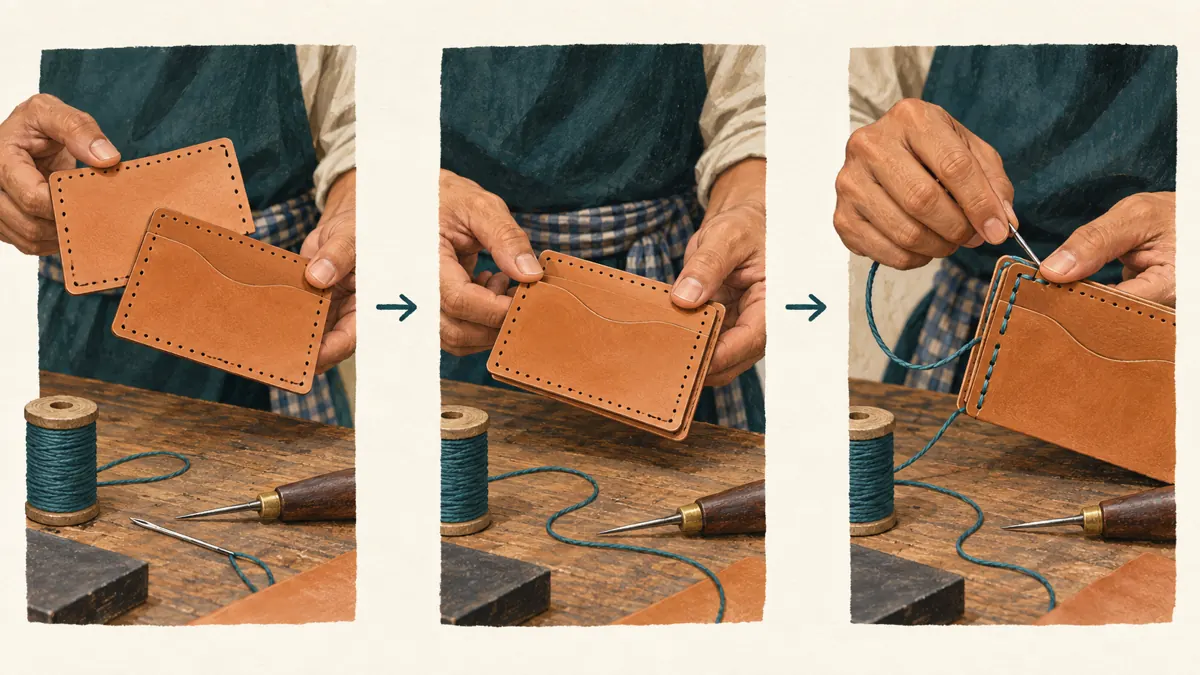
For a hypothetical cardholder clip, begin by showing the two panels separately, then show their alignment before the stitching close-up. The point is not to turn a short excerpt into a complete lesson. It is to keep an essential preparation step from disappearing. If understanding requires a long warning or several previous steps, choose a simpler moment for reuse. A finished seam comparison may be more suitable than an isolated tool operation. Ask a colleague unfamiliar with the recording to describe what they think happened, and revise any misleading ambiguity.
4. Prepare material that the shop can comfortably share
Use a demonstration sample rather than a customer’s personalised order. Remove delivery labels, private messages, order slips and identifiable custom details from the frame. Ask anyone whose face or voice appears whether they are comfortable with the proposed public use, including reuse by other creators. Record what was agreed in the production notes so another employee does not have to guess later.
Listen to the background as carefully as you inspect the table. Shop music, a neighbouring television or a customer conversation can enter an otherwise clean recording. When uncertain, record a fresh explanation in a quieter space. Keep a version containing only the shop’s intended voice and workshop sounds.
For Cambodian viewers, use the language that makes the demonstration understandable to the intended audience. Have a fluent Khmer speaker review any Khmer explanation, especially material names and measurements. An English product nickname should not replace a clear explanation of which leather piece or tool the artisan means.
5. Check the actual controls before promising reuse
In YouTube Studio, open Content, select the video, choose Show more and locate Shorts remixing. Review the available choice and save. YouTube distinguishes ordinary Shorts video-remix controls from broader controls available to certain partners; do not promise that every account can disable every form of reuse. Consult the official remix guidance linked above.
Write down the video address, the option displayed, the decision and the review date. Describe what the screen actually says rather than translating it into a vague note such as “protected.” That word could lead a colleague to assume the video cannot be copied or reused in any way.
Check the particular upload you intend to promote. A decision recorded for an earlier demonstration is not a reliable record for a new one. If the available controls do not match the shop’s requirements, pause the reuse invitation and reconsider the footage. Do not compensate for an unsuitable setting with a caption that promises control the shop does not have.
6. Make a useful destination for interested Cambodian buyers
Imagine that someone arrives because they liked the stitching detail. Their next question may be whether the shop sells finished cardholders, teaches workshops or supplies leather. State that distinction plainly in the accompanying product explanation. Include the relevant contact route and ask for information that helps the shop answer, such as the desired item and colour.
For a hypothetical Siem Reap maker selling finished products, a useful invitation would ask viewers to send the product reference and their preferred collection or delivery arrangement. It should not imply that delivery is available everywhere or that every displayed colour remains in stock. Confirm those details before making an offer.
Keep the demonstration separate from changing stock information. A stable technique explanation can remain useful after a particular colour sells out. Staff should be able to update the buying information without rewriting what the video demonstrates. This also makes it easier to explain whether a viewer is asking about the sample, a current item or a custom variation.
7. Review an SMM listing against the real objective
An SMM panel listing should be assessed against the task you actually need completed. If the objective is to receive thoughtful craft responses or relevant product enquiries, a subscriber listing does not describe that outcome. The brief includes the exact public service name “YouTube - Subscribers - 𝐁𝐎𝐓 ~ Max 10k ~ 10k/day ~ Instant ~ 𝐍𝐎 𝗥𝗘𝗙𝗜𝗟𝗟”. Its category identifies a subscriber service, and its description is empty. The title’s delivery claims are not independently verified evidence.
YouTube prohibits artificial increases in engagement metrics and warns that a hired promoter’s actions can affect the channel. Reject methods that artificially inflate engagement. [YouTube’s fake engagement policy](https://support.google.com/youtube/answer/3399767?hl=en) provides the relevant boundary.
Purchased engagement cannot establish genuine interest, sales, advertising delivery or Cambodian audience origin. A larger counter also cannot show whether someone understood the stitching sequence. Before allocating money, identify the unresolved problem: unclear footage, missing product information, unanswered enquiries or insufficient distribution. Do not assume that an available panel service addresses any of those problems merely because it mentions YouTube.

8. Plan corrections before other videos depend on yours
YouTube says restricting remixing, deleting the source or making certain Studio edits can affect existing remixes. Video remixes may be deleted; affected audio remixes can be muted, unlisted and scheduled for deletion. Review the official guidance before changing a source that others have used.
Keep a simple record of planned collaborations: source video, collaborator, agreed subject and any known publication timing. This is a practical coordination record, not a promise that you control every subsequent use. If you discover a misleading demonstration, correct the underlying problem rather than preserving it solely to avoid inconvenience.
In a hypothetical workshop, the owner notices that a spoken measurement refers to an earlier sample. First establish the correct information and whether the error affects the demonstrated method. Then decide how to correct the source and prepare a clear explanation for known collaborators. Avoid quietly changing several things at once; a precise correction makes it easier for everyone to understand which part needs attention.
9. Read the response as evidence of specific questions
YouTube’s reach reports include a Remixed video traffic source for views arriving from visual remixes. That provides one piece of context, not a complete account of purchasing intent.
Keep a separate enquiry log containing only information needed to understand the business question. Useful categories include finished-product availability, material choice, workshop attendance and technique clarification. Record confirmed orders separately from enquiries. A question about how the seam works is valuable feedback, but it is not automatically a request to buy.
At a review date chosen in advance, compare the intended message with the questions actually received. If viewers repeatedly ask whether the panels were punched beforehand, the footage needs a clearer preparation shot. If they ask whether the shop sells supplies, the offer needs a clearer description. These observations suggest specific edits. An engagement total alone cannot tell you which explanation is missing, and a quiet response does not identify its cause without further evidence.
10. Avoid changes that make the demonstration harder to trust
Common mistakes include removing preparation to make the craft look effortless, allowing a sample to look like a guaranteed product specification, and treating every reused clip as an endorsement. Another is choosing a soundtrack before checking whether the spoken explanation remains intelligible. Each mistake makes it harder for viewers to understand what the shop is actually showing.
Use a simple decision process. Proceed when the excerpt makes sense, the material is suitable for reuse, the available controls match the intended plan and someone can handle follow-up questions. Revise when the idea is useful but essential context is missing. Pause when permission is uncertain or the desired promotion depends on artificial engagement.
Assign one person to make the final content decision and another to test the explanation as a viewer. The second person should report what they understood, not merely whether the video looks attractive. This keeps the review focused on a practical outcome: a prospective customer can recognise the craft, understand its limits and ask a relevant next question.

Frequently asked questions
Should every stitching video be offered for remixing?
No. Choose material that remains understandable as a fragment and that the shop is comfortable seeing in other contexts. A simple comparison may work better than a sequence requiring extensive preparation. Review each video individually instead of assuming that one decision suits the entire channel.
What if a creator interprets the technique differently?
First identify whether the disagreement concerns preference, missing context or a factual mistake. Explain the materials and conditions used in your demonstration. If your own footage caused the confusion, improve it. Do not describe a differing craft opinion as a false customer review when the creator never claimed to be a customer.
Can we tell whether a remix brought Cambodian customers?
A view or remix alone cannot establish that. Relevant enquiries may provide useful context when people voluntarily explain what they need and where collection or delivery would occur. Keep those observations separate from assumptions about the entire audience, and avoid collecting personal information that is unnecessary for answering the enquiry.
Should a small shop pay for promotion before fixing the explanation?
Fix an identifiable explanation problem first. Wider distribution of an ambiguous demonstration can multiply the same unanswered question. After revising, test whether a colleague can identify the product, the demonstrated action and the next step. Assess any paid option by its documented method and suitability, not by an attractive counter.
Explore the current service catalogue, create an account, or ask a specific question through support tickets.
Prepared with AI assistance. Illustrations explain the workflow and do not represent customer results.